
Training Equals Increased Productivity
According to Andy Routsis, President of Routsis Training, “By significantly improving the skill level of the workforce, companies have increased their productivity by at least 37% within the first year.”
Which company doesn’t want greater productivity? The obvious answer is None! So, how do you increase the skill level of your workforce? Again, an obvious answer – Training!
But you might argue, employee training is expensive, and it can be difficult to measure the impact or value, and it takes up valuable time. But having “a fully implemented training system in place as part of your continuous production operations” for your plastics manufacturing plant, according to www.ptonline.com, provides companies with benefits such as “less damage to injection molds and extrusion dies, reductions in unplanned machine downtime, improved part quality and consistency, a safer production floor, and a repeatable, reliable process.”
So, if you’re going to implement a training system, what are some key factors? In the article, “6 Keys to Developing a Skilled Plastics Workforce,” Routsis Training shares what it considers the six critical factors for your company’s in-house training program.
1. The information being presented must be relevant to the workplace.
2. Training must be captivating in order to keep the participants’ attention.
3. Employees retain significantly more information in an interactive environment.
4. Curriculum must be tailored to meet the specific needs of your plant.
5. Participants must develop skills that can actually be used.
6. Tracking the results proves the effectiveness of the training.
Does training really work? Team 1 Plastics, a plastic injection molding company for the automotive industry, recently decided to find out. This past summer, as part of its focus on continuous improvement in all aspects of its business, the company hired its first-ever Trainer, Danielle Sheldon, who has been tasked with developing position-specific training programs for new hires. The first training program developed by Sheldon is for Production Assistants – an entry-level position that is filled primarily by Temporary Agency placements.
Initially hired into Team 1 Plastics as a Production Assistant, Sheldon had experienced first-hand the training that was previously done for this position. “One big issue that I saw personally when I was a Production Assistant was if I were to cover for a different shift, they would do things so much differently. And in a manufacturing facility, you cannot do that. So, having consistency and solid standards across all shifts was really important.”
Sheldon said that a new hire was immediately placed on the production floor without any preliminary training. A training document, called the Captain Orientation Form, was the guide for the different Team Captains to use for the “on-the-job” training of the new hire. However, the Captain Orientation Form was very vague. It was a check list of what subjects to cover, but it didn’t contain specific information. And, it didn’t include any training of how the Production Assistant’s position fit within the company’s structure. Sheldon said that when she was on the production floor, she didn’t receive a lot of information about what happens to the parts they were making. She said that she wondered, “After I put them on the skid, where do they go? What do the other departments do with them?”
And general orientation information for a new hire was minimal. The orientation consisted only of an Orientation Breakfast with Craig Carrel, President of Team 1 Plastics. In Sheldon’s case, “I didn’t have that until a month after I had started.”
The information being presented must be relevant to the workplace.
Team 1 Plastics’ new approach to training is to give the Production Assistants a good foundation before they start working on the production floor. Each Production Assistant begins at Team 1 with a two-day training program. The first day includes an Orientation of Team 1 Plastics, conducted by Robert Clothier, Human Resource Manager. The new hire learns about the company, its products, its history, and its customers; and topics like the dress code and how the time system works are discussed.
During the rest of day one of training, Sheldon takes the new hire through a five-hour position-specific training. Much of the focus of this training is helping the new Team Member understand the importance of his/her position in relationship to the other departments and to the customer. What is the whole process to producing and delivering quality parts to the customer? What happens to the parts you are producing? How does your work affect the other departments? Why is it so important that we pay attention to the details on the labels? Why do we make sure we pay attention to the manufacturing standards?
Training must be captivating in order to keep the participants’ attention.
The second day of training for new hires at Team 1 Plastics includes a two-hour shadowing of Sheldon on the production floor with “hands on” training. Sheldon said that when she was developing the training program, she surveyed the current Production Assistants and Captains and asked, “What is your favorite training style?” Most of the responses were “on-the-job” training — which is why much of the training occurs through the shadowing experience.
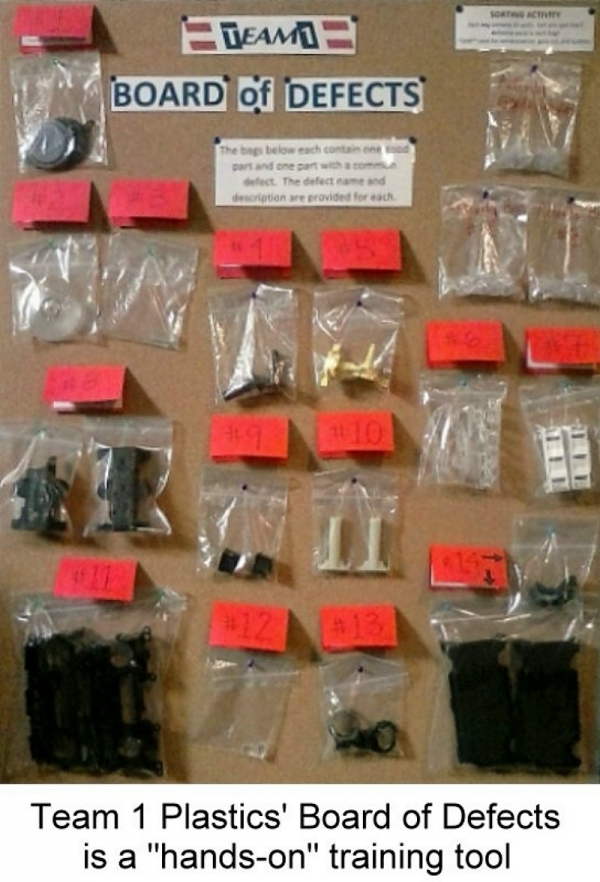
Other tools that Sheldon has developed include PowerPoint presentations to help with structure of the training, paper resources, such as a guide on how to read a label, and a Defect Board.
Employees retain significantly more information in an interactive environment.
The Defect Board contains 14 different types of defects that are commonly seen in the plant. For each defect, there is a bag with a good part and a bad part. The board shows the name of the defect and the definition of it and/or what could cause the defect. Trainees see and handle both good parts and bad parts and then participate in a matching activity as part of their assessment and retention training.
Curriculum must be tailored to meet the specific needs of your plant.
As she was developing the content for the training program, Sheldon visited with Managers in different departments to find how out the work in Production affected their departments. She learned that labeling errors were greatly affecting other departments and causing extra work for them. Reducing labeling error became a key focus for the Production Assistant training program.
Participants must develop skills that can actually be used.
Sheldon tested the effectiveness of the training by having different groups of current Team Members go through the training. “When I had my first draft of the program completed, I used all of the current Production Assistants as my Pilot group.” In addition, she has presented the training to all Production Captains and Quality Auditors to get their input on the content and to help them understand the work expectations for the Production Assistants. As Sheldon said, “I have only been here at Team 1 since March, and there are some individuals who have been here for years and could give me some input. I could have all of these ideas in the world, but if I could get some input from people who have been here longer, that’s just going to make the training program better.”
Tracking the results proves the effectiveness of the training.
Even though the Production Assistant training program has only been implemented for a few months, already Team 1 Plastics is seeing positive results. Labeling errors are down 50.4% since implementation of the training was begun in August 2016.
Individuals have experienced success as well. Each person who has gone through the training has achieved the required 75% passing grade on the learning assessment, demonstrating that the training is effective and that the participants are retaining the information. In addition, one of the first Temporary Agency employees to go through the training program was recently hired by Team 1 Plastics as a permanent Team Member.
Team 1 Plastics plans to develop training program for other positions in the company. Sheldon said the Production Assistant training program can be used as a model for development of training programs for other positions. “This program is setting a good foundation for the future of Team 1 Plastics. I feel that the hard work that I am putting in right now will, in a couple of years down the road, completely set a different tone and environment at Team 1. I’m really glad to be a part of that and have this opportunity to set the stage for something that will be very successful for the company.”


Danielle Sheldon says:
Jeffery Carrel says:
Jeffery Carrel says: